AI-Guided Association Organizational Intelligence
Organizations deserve more than information.
They deserve understanding.
AssocModel is an AI-Guided Association Organizational Intelligence platform that helps association leaders understand their organization, govern AI responsibly, and make better-informed decisions.
Association executives have more reports, dashboards, forecasts, and data than ever before. Yet organizations continue to be surprised by structural risk, hidden dependencies, and gradual organizational change that traditional planning rarely reveals.
AssocModel continuously synthesizes Organizational Intelligence across finance, membership, sponsorship, events, governance, operations, and strategy — helping executive teams understand what is changing before important decisions are made.
- Structural Exposure
- Know where the organization is quietly becoming load-bearing before those dependencies become strategic risk.
- Operating Pressure
- Understand the structural forces quietly accumulating beneath otherwise reasonable plans.
- Governance Confidence
- Transform AI-generated insight into disciplined, board-reliable executive intelligence.
- Organizational Resilience
- Continuously strengthen the organization's long-term structural capacity rather than simply reacting to disruption.
Executive Insight
The Next Evolution of Executive Leadership
For decades, executive leadership focused on improving access to information. Today, information is abundant. The new leadership challenge is understanding.
AI now enables organizations to continuously recognize patterns, relationships, structural exposure, operating pressure, and emerging organizational change that were previously difficult to see.
That capability is Organizational Intelligence. AssocModel is purpose-built to bring it to associations.
Why Now
Why AI Changes Executive Leadership
Recognize Structural Patterns
Relationships across years of financial and operational information become visible as patterns rather than isolated results.
Connect Information Across Domains
Finance, membership, sponsorship, events, staffing, and governance are read together instead of separately.
Detect Hidden Dependencies
Concentration and reliance that no single report exposes are identified while there is still time to respond.
Surface Emerging Blind Spots
Conditions forming beneath the plan are raised before they become operational or governance problems.
Prioritize Executive Attention
Leadership is directed toward what is structurally consequential rather than what is merely recent.
Continuously Synthesize Intelligence
Understanding is maintained as conditions change, not assembled once a year for a planning cycle.
Leadership remains human. Understanding becomes exponentially stronger.
A New Executive Discipline
Organizational Intelligence explains the organization itself.
AssocModel is not simply another planning platform. It establishes a new executive discipline: AI-Guided Association Organizational Intelligence.
Traditional planning explains performance. Organizational Intelligence explains the organization itself.
Forecasts remain essential. Budgets remain essential. Governance remains essential. AssocModel continuously helps leadership understand the relationships beneath them.
Structural Exposure
Where the association is concentrated, where it is dependent, and what the loss of any load-bearing element would actually cost.
Operating Pressure
The recurring pressure accumulating across membership, sponsorship, events, training, and the expense base that supports them.
Governance Reliability
Traceable, board-defensible analysis with a clear separation between exploration and positions of record.
AssocModel
One evolving organizational understanding.
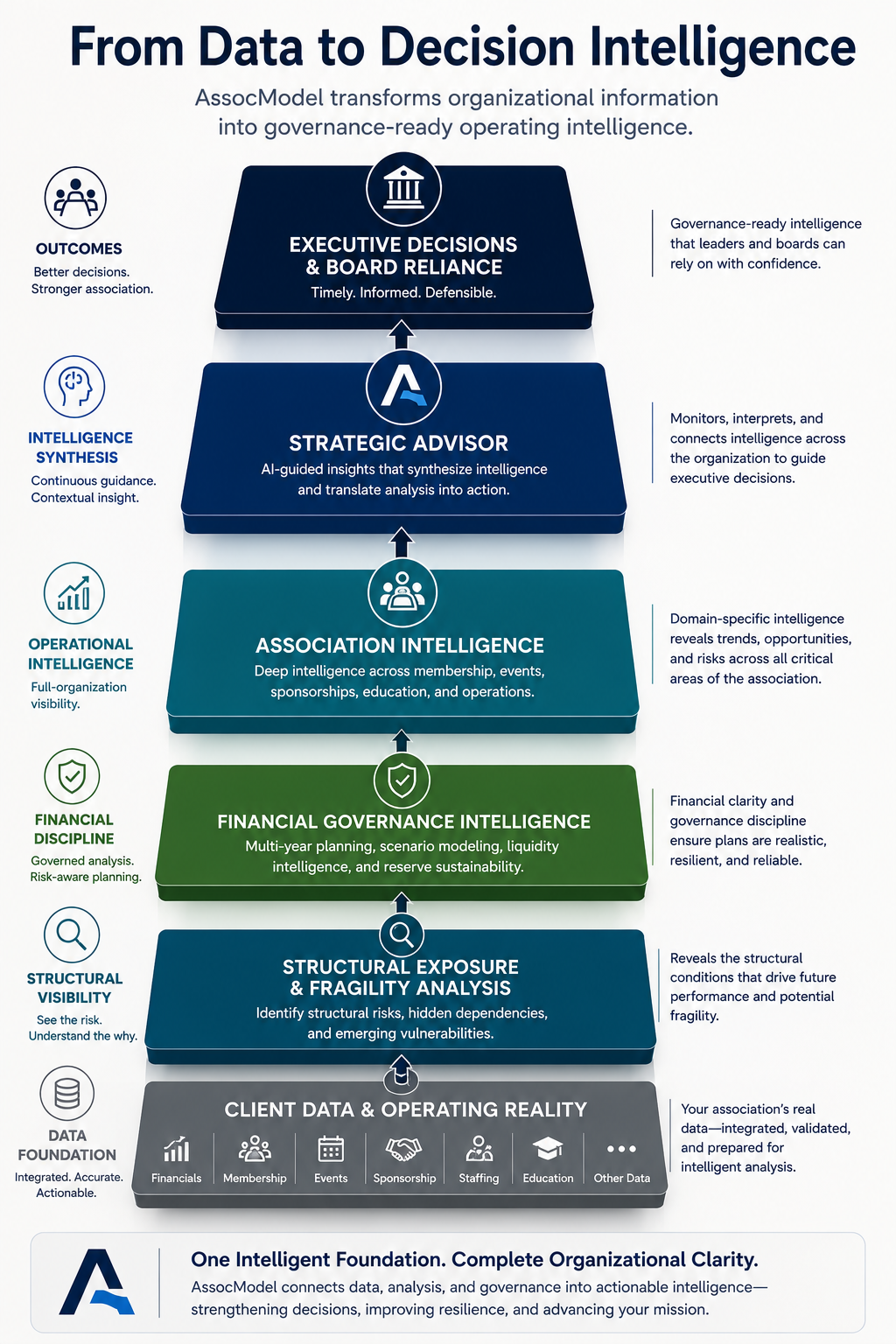
AssocModel continuously synthesizes Organizational Intelligence across the entire association.
Rather than analyzing finance, membership, sponsorship, events, staffing, governance, and strategic planning independently, AI continuously connects these domains into one evolving organizational understanding.
The result is stronger executive awareness, better governance, and more confident strategic decisions.
The Core Idea
Every Organization Has Two Realities
Leaders naturally measure organizational performance: revenue, expenses, membership, events, reserves, budgets, dashboards.
These indicators are essential. But they do not fully describe the condition of the organization beneath them.
The strongest organizations understand both organizational performance and organizational condition.
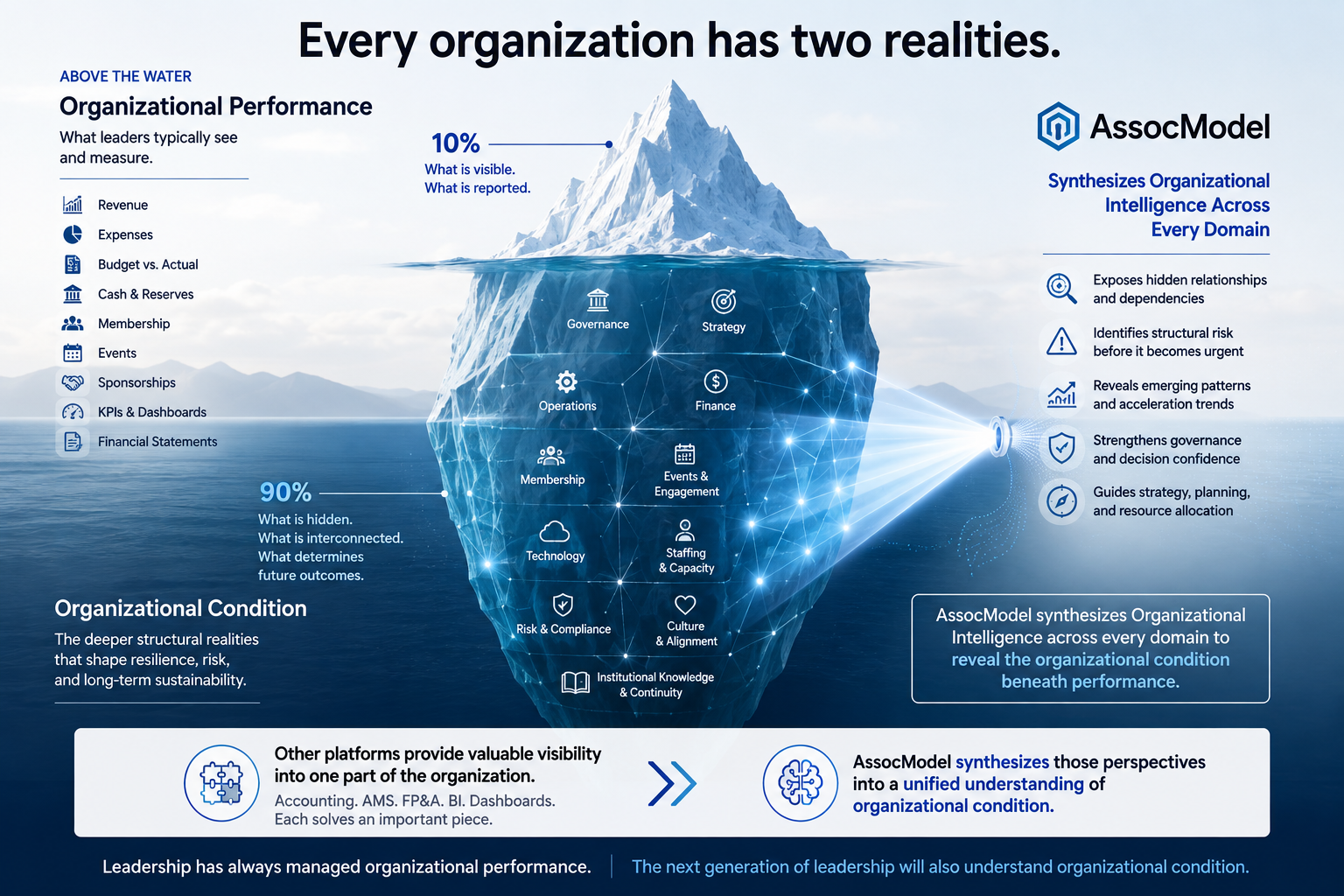
Above the Water
Organizational Performance
What leaders typically see:
- Revenue growth
- Budget performance
- Membership trends
- Event attendance
- Sponsorship revenue
- Cash reserves
- KPIs and dashboards
Performance explains outcomes. It tells leadership how the organization is performing today.
Beneath the Water
Organizational Condition
What leadership must also understand:
- Structural dependencies
- Revenue concentration
- Governance capacity
- Operational complexity
- Leadership resilience
- Knowledge concentration
- Strategic flexibility
- Emerging risk
Condition explains what the organization is becoming. It determines resilience, adaptability, and long-term sustainability.
Traditional systems provide visibility into individual parts of the organization.
AssocModel synthesizes organizational intelligence across every domain to reveal the organizational condition beneath performance.
Visibility Is Not the Same as Understanding
Traditional systems help organizations understand accounting, membership, events, dashboards, forecasting, and reporting. Each provides valuable visibility.
- Accounting
- Membership
- Events
- Dashboards
- Forecasting
- Reporting
But executive leadership requires something more: an understanding of how all of those pieces interact and shape the future condition of the organization.
AssocModel synthesizes organizational intelligence across finance, operations, governance, membership, staffing, technology, and strategy to help leadership recognize patterns, relationships, and structural changes before they become urgent.
Leadership has always managed organizational performance.
The next generation of leadership will also understand organizational condition.
Organizations deserve more than information. They deserve understanding.
Purpose-Built for Associations. Not Adapted to Them.
Most planning platforms began as enterprise financial software or generic AI platforms and were later modified to serve nonprofits or associations. They were adapted to a world they were not originally designed to understand.
AssocModel followed the opposite path. It began with the operating realities of trade and professional associations. Purpose-built AI was then developed around those realities — not the other way around.
Membership
Purpose-built around dues economics, recruitment, retention, engagement, and member value.
Sponsorship
Purpose-built around sponsorship concentration, renewal behavior, strategic partnerships, and revenue dependency.
Events & Conferences
Purpose-built around event operating leverage, attendance volatility, contribution analysis, and conference economics.
Governance
Purpose-built around executive accountability, board reliance, fiduciary transparency, and disciplined decision support.
Structural Exposure
Purpose-built to identify hidden organizational dependencies that traditional planning systems rarely reveal.
Organizational Intelligence
Purpose-built to continuously synthesize financial, operational, governance, and strategic information into executive understanding.
Purpose-built systems understand the organizations they serve. Adapted systems learn around them. AssocModel was intentionally designed around the operating realities of associations from the beginning.
Why Traditional Planning Misses Structural Risk
A balanced budget is not a resilient organization.
Single-year budgets hide multi-year erosion
A budget that balances this year can disguise a reserve trajectory that will not survive the next three. The fiscal year is the wrong unit of governance.
Forecasts smooth the concentration that matters
A single sponsor, certification, event, or category can quietly represent a disproportionate share of operating reality — and disappear without warning.
Reserves are measured, not stress-tested
Knowing the reserve balance is not the same as knowing how many operating months it sustains under credible pressure. Boards deserve the second number.
Governance receives snapshots, not signal
Boards see point-in-time reports. Structural risk is a trajectory. Without recurring intelligence, drift is recognized only after it has become disruption.
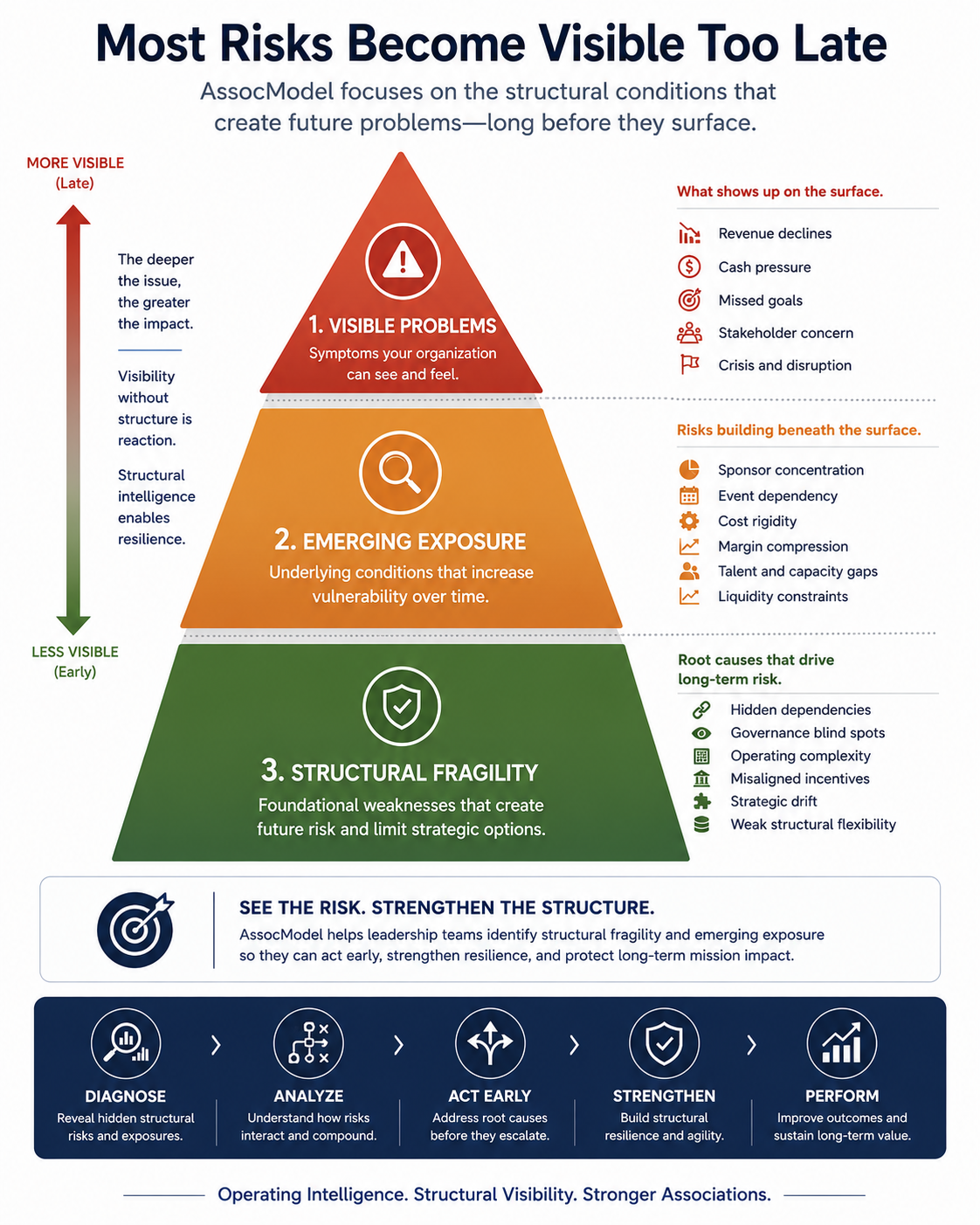
Most Risks Become Visible Too Late
AssocModel helps leadership recognize structural fragility before it becomes operational disruption.
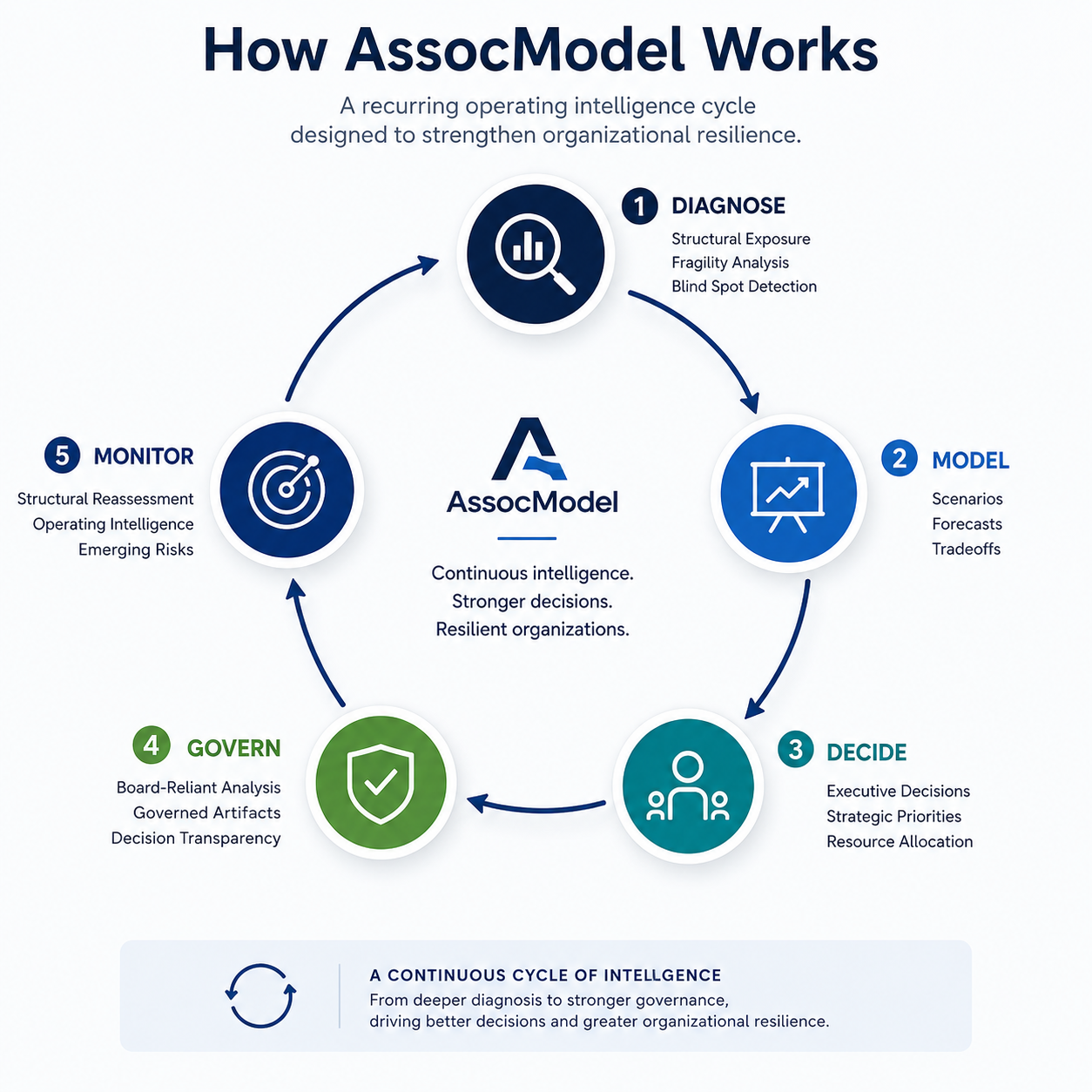
How AssocModel Works
Four disciplined layers of organizational intelligence.
I
Structural Exposure & Blind Spot Analysis
Establish the association's structural baseline — revenue composition, reserve durability, dependency exposure, and absorption capacity. Produces a Blind Spot Heat Map with mitigation and response modeling.
II
Operating Framework
Codify the recurring operating model — membership, sponsorship, events, training, expense behavior — as a coherent governance object.
III
Scenario Intelligence
Stress-test the structure against credible economic, demographic, sponsorship, and event-cycle pressure. Quantify what the organization can absorb.
IV
Structural Monitoring
Move from one-time analysis to recurring, board-reliant intelligence delivered on a cadence the executive team and fiduciaries can trust.
Who AssocModel Is For
The executives accountable for organizational resilience.
Association CEOs
Accountable for the long-term viability and strategic direction of the institution.
COOs
Responsible for the operating discipline that turns strategy into durable outcomes.
CFOs & Finance Leaders
Stewards of reserves, liquidity, and the structural integrity of the financial model.
Executive Committees
Charged with translating strategy into governance-grade positions of record.
Governance-Focused Boards
Fiduciaries who require traceable, recurring intelligence — not anecdote or assurance.
The Senior Team
Department leaders coordinating membership, events, sponsorship, and training within a single operating frame.
Closing
Leadership has entered a new era.
Organizations no longer need more information. They need deeper understanding.
AI-Guided Association Organizational Intelligence helps executive teams recognize structural change earlier, strengthen governance, and build more resilient organizations over time.
AssocModel was built to make that possible.