
Pilot Program — By Invitation and Inquiry
A selective implementation. Not a software trial.
Implementation Journey
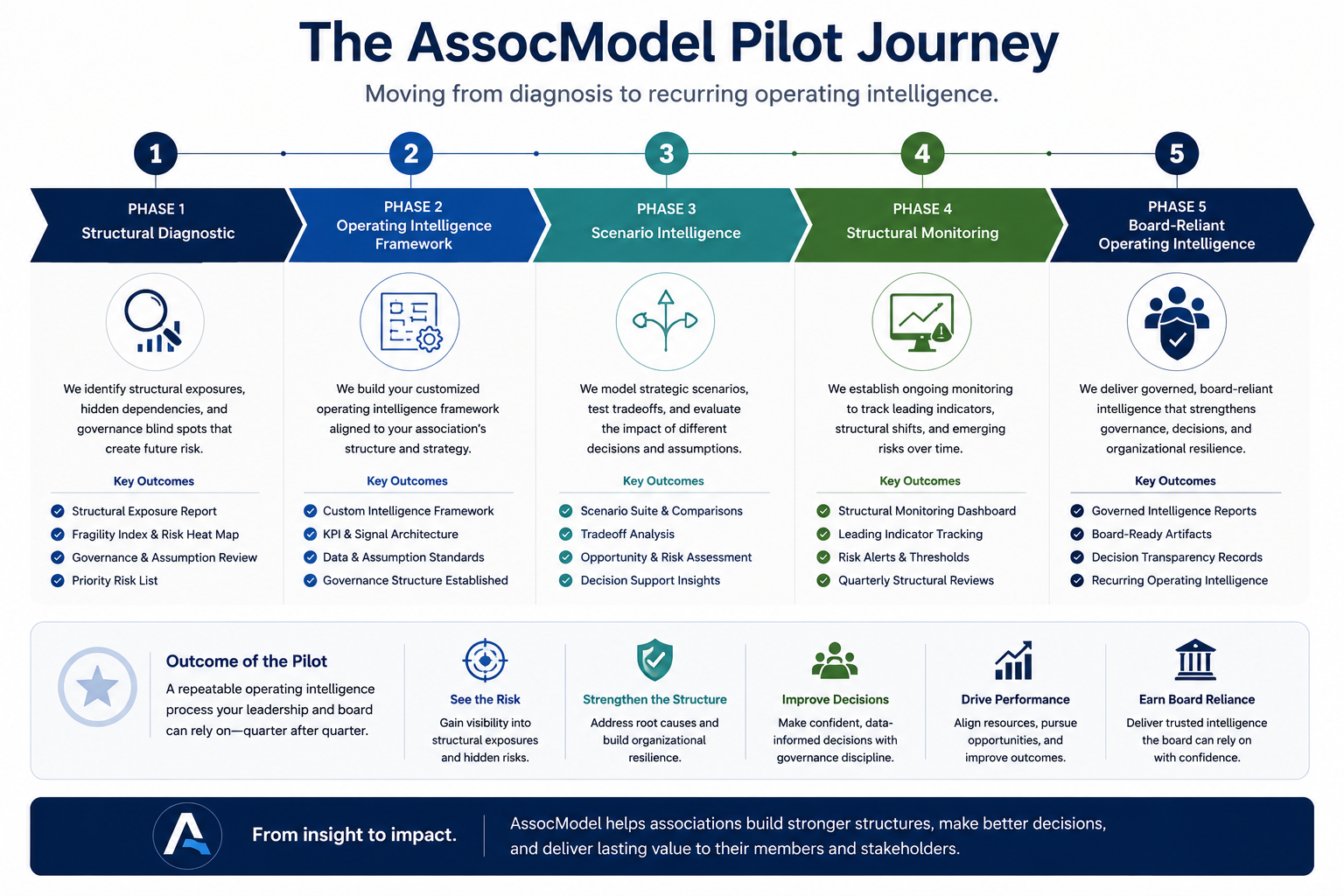
The AssocModel Pilot Journey
The implementation journey shows how Organizational Intelligence becomes embedded into an organization's recurring executive operating rhythm. Each phase progressively deepens the association's ability to generate, interpret, and govern that intelligence — not as a one-time exercise, but as a lasting executive capability.
01 — Ideal Pilot Profile
The associations this pilot is built for.
Governance sophistication
A board that takes its fiduciary role seriously, expects analytical rigor, and is prepared to rely on intelligence between meetings — not only react to reports inside them.
Structural complexity
An operating model with meaningful dependencies — sponsorship concentration, flagship events, certification programs, multi-year reserves — where structural exposure is consequential, not theoretical.
Executive participation
A CEO and CFO who will personally participate in the engagement. This is not delegated to a director of finance or a project manager.
02 — Cohort Composition
Industries represented in the current cohort.
Construction associations
Cyclical industries with sponsorship concentration and material training program weight.
Healthcare associations
Regulatory exposure, certification economics, and event-driven revenue structure.
Financial services associations
Governance-intensive boards with low tolerance for analytical ambiguity.
Manufacturing associations
Industry-cycle sensitivity and meaningful sponsorship structure.
Technology associations
Fast-moving membership categories and event-led operating models.
Governance-focused nonprofits
Mission-driven organizations with fiduciary boards and serious reserve responsibility.
Diversity across industries allows AssocModel's AI reasoning engine to mature across multiple operating environments while preserving association-specific intelligence. Each sector contributes distinct structural conditions, ensuring the platform develops governance-grade reasoning that remains true to the complexity of association leadership everywhere.
03 — Executive Participation
The seat at the table is the CEO's and the CFO's.
Chief Executive
Engages on structural posture, mission durability, and the framing the board will ultimately rely on.
Chief Financial Officer
Owns the structural diagnostic and the integrity of the Organizational Intelligence record.
Executive Committee Chair
Participates where appropriate to align the work with governance expectations.
Senior Operating Leadership
Brought in selectively to ground the framework in operational reality — not as a substitute for executive participation.
04 — The Implementation
Five disciplined phases.
Phase 01
Structural Diagnostic
A confidential assessment of the association's structural baseline — revenue composition, reserve adequacy, dependency exposure, and absorption capacity — conducted directly with the CEO and CFO.
Phase 02
Organizational Intelligence Framework
The recurring operating model is codified across membership, sponsorship, events, training, and expense behavior, and reconciled against the board's stated risk posture.
Phase 03
Scenario Intelligence
Structural stress-testing against credible economic, demographic, sponsorship, and event-cycle scenarios — surfaced in language the executive committee can defend.
Phase 04
Structural Monitoring
The recurring intelligence cadence is stood up — quarterly and event-driven — and integrated into the actual operating rhythm of the executive team and board.
Phase 05
Board-Reliant Organizational Intelligence
AssocModel becomes the trusted Organizational Intelligence layer the executive committee and board return to between meetings, and the durable record successor leadership inherits.
05 — What the Pilot Is Not
A short list, for clarity.
Not a software trial
There is nothing to evaluate in a sandbox. The engagement begins inside the association's actual operating reality.
Not a consulting study
There is no deliverable that lives on a shelf. The output is a durable Organizational Intelligence layer the executive team and board rely on.
Not a workshop
The work is sequenced, executive-led, and accountable to the structural questions the board is responsible for answering.
Not delegable below the executive line
Participation by the CEO and CFO is a condition of the engagement, not a preference.
Why Participate Now
Four reasons executive leaders are engaging now.
Shape the Future
Help define the next generation of AI-guided association Organizational Intelligence.
Early Strategic Advantage
Gain executive insight unavailable through traditional planning methods.
Direct Founder Collaboration
Work directly with Patrick Mixon throughout implementation, helping shape the platform while receiving executive-level guidance.
Influence the Platform
Provide strategic feedback that directly informs the evolution of AssocModel's AI reasoning, governance architecture, and Organizational Intelligence framework.
Engagement
Pilot participation is by inquiry.
Pilot organizations are not simply early adopters. They are helping establish a new executive discipline built upon recurring Organizational Intelligence, governance discipline, and executive accountability — a capability that will define how serious associations are led for years to come.
Request Executive Demonstration