A New Executive Discipline
Organizational Intelligence
The next evolution of executive leadership.
Organizations have become more interconnected, more complex, and more dynamic than ever before.
Financial reports, dashboards, budgets, and forecasts remain essential, but they were never designed to continuously explain how an organization itself is evolving.
AI now makes continuous Organizational Intelligence possible.
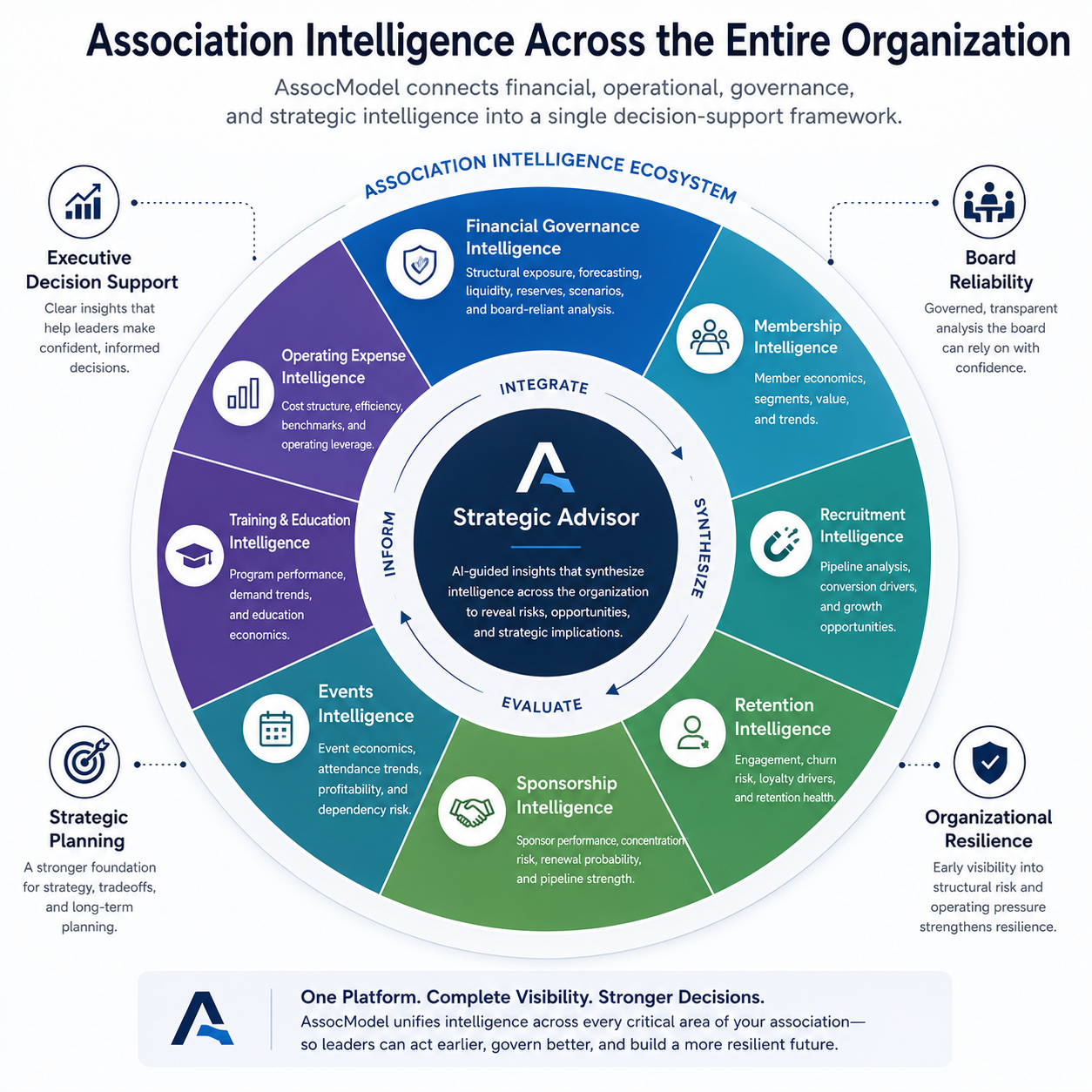
AssocModel continuously synthesizes intelligence across finance, membership, sponsorship, events, governance, staffing, operations, and strategy — helping executive teams understand structural change before it becomes organizational disruption.
Definition
What Is Organizational Intelligence?
Organizational Intelligence is the continuous understanding of how an organization is evolving beneath traditional reporting.
It explains not only what is happening, but why it is happening, what relationships are changing, what structural conditions are emerging, and what executive leadership should understand before making important decisions.
Unlike traditional planning, Organizational Intelligence continuously synthesizes information across every major operating domain into one evolving executive perspective.
It transforms information into understanding.
Enabling Capability
Why AI Changes Organizational Intelligence
- •Recognizes structural patterns
- •Connects relationships across operating domains
- •Detects hidden dependencies
- •Identifies emerging organizational pressure
- •Prioritizes executive attention
- •Continuously reassesses organizational conditions
AI strengthens executive judgment.
It never replaces executive accountability.
The Distinction
Why Organizations Need Organizational Intelligence
Traditional executive reporting answers
What happened?
Budgets answer
What do we expect to happen?
Organizational Intelligence answers
What is changing beneath the organization?
That distinction represents one of the most important advances in executive leadership made possible by AI.
The Model
The Organizational Intelligence Model
Layer 1
Structural Intelligence
Understanding structural exposure, dependency, resilience, and fragility.
Layer 2
Operational Intelligence
Understanding how finance, membership, sponsorship, events, staffing, governance, and operations continuously interact.
Layer 3
Executive Intelligence
Synthesizing organizational understanding into executive reasoning, prioritization, and decision support.
Layer 4
Governance Intelligence
Transforming executive understanding into disciplined, board-reliable organizational decisions.
Interconnection
Organizations Are Living Systems
Associations should no longer be viewed as independent departments.
AI continuously recognizes these relationships and synthesizes them into Organizational Intelligence.
Leadership receives one evolving organizational perspective rather than disconnected reports.
Membership influences events.
Events influence sponsorship.
Sponsorship influences reserves.
Technology influences operations.
Operations influence governance.
Governance influences strategy.
Cadence
Organizational Intelligence Is Continuous
Organizational Intelligence is not created during budget season.
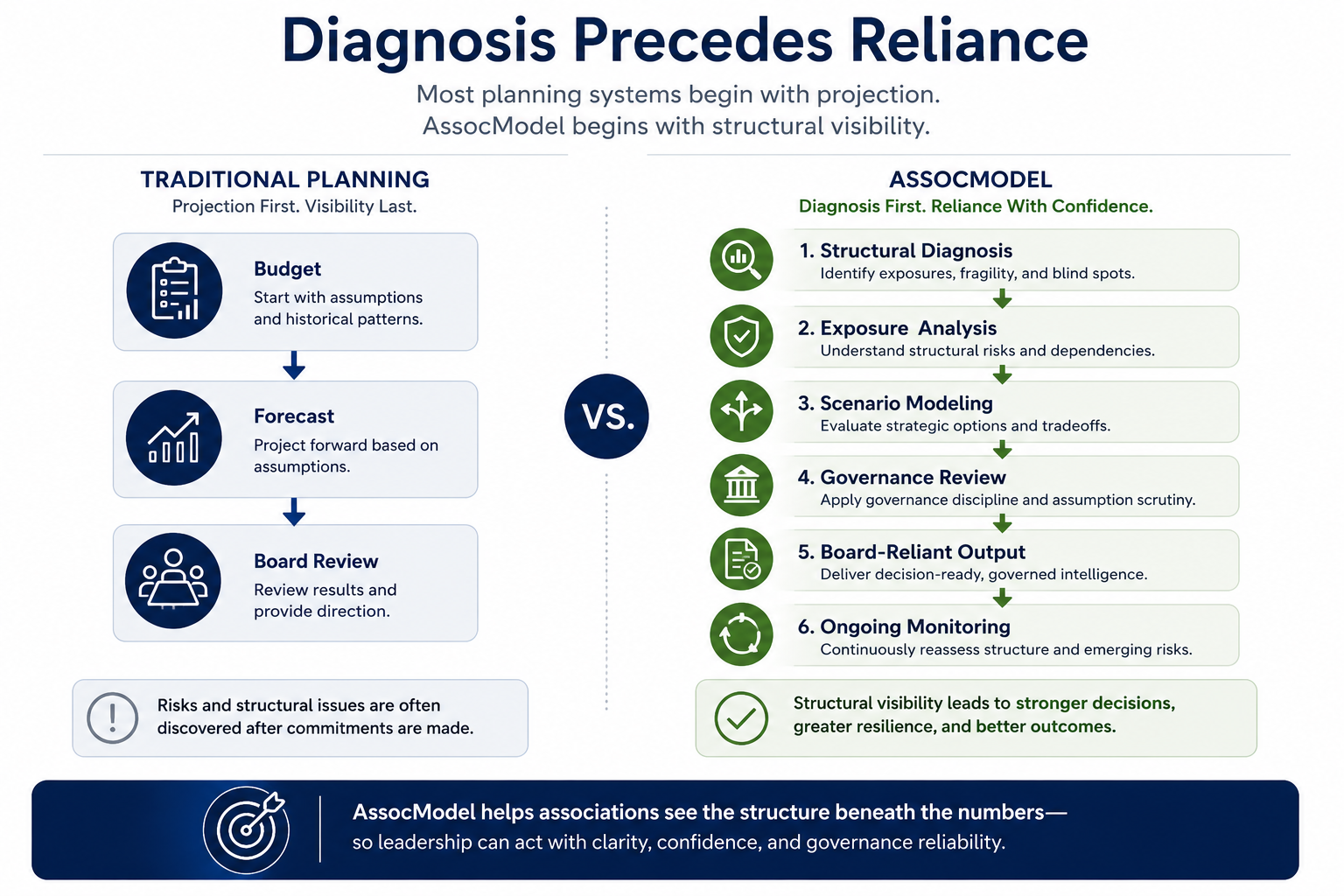
It evolves continuously. Monthly. Quarterly. Between board meetings. As organizational conditions change.
Leadership no longer waits for annual planning to understand organizational condition.
AssocModel continuously synthesizes Organizational Intelligence as the organization evolves.
Category Differentiation
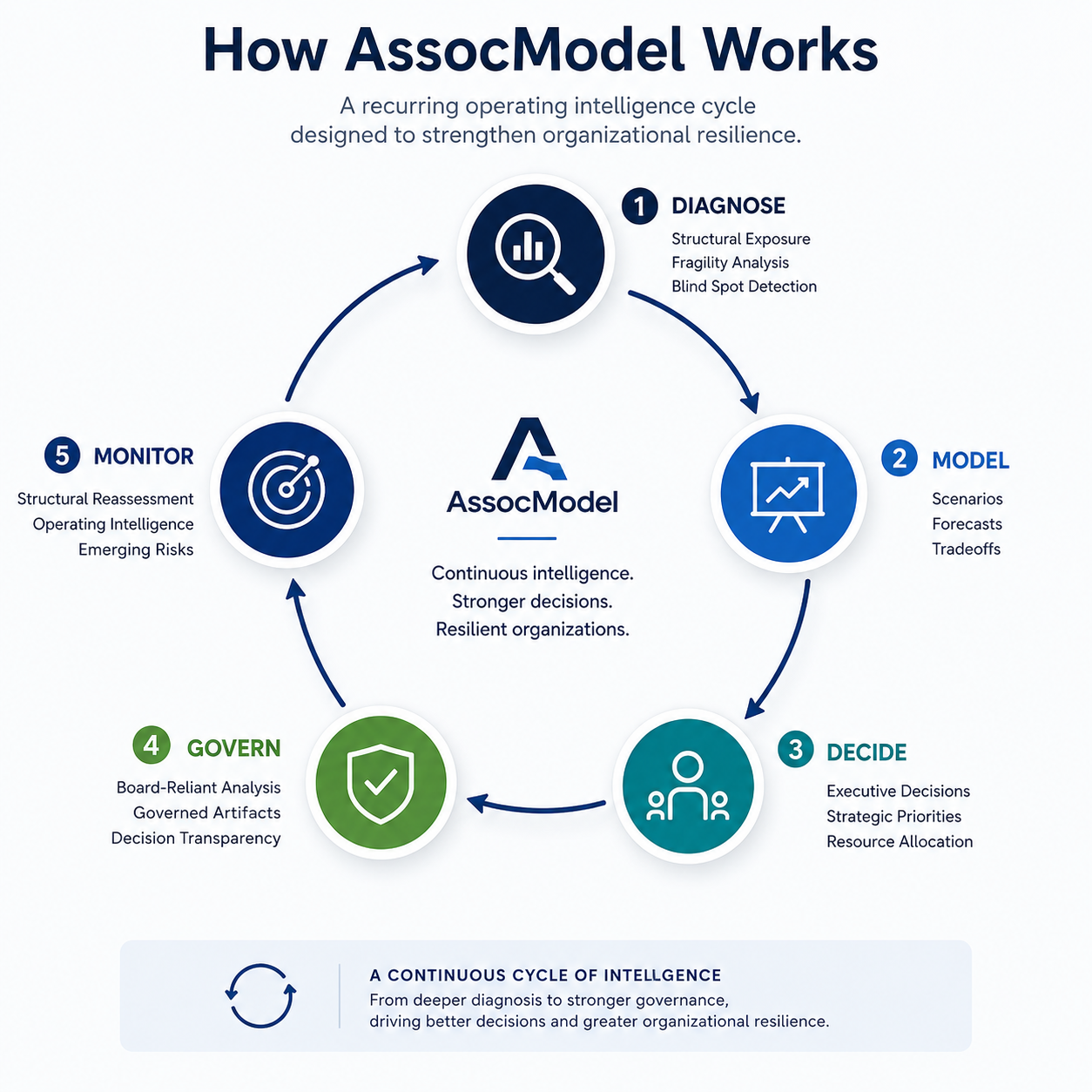
Diagnosis Precedes Reliance
Traditional planning begins with projection.
AssocModel begins with structural visibility.
Structural Exposure
Where the organization is quietly load-bearing.
Structural exposure is the set of dependencies an association cannot easily replace. A dominant sponsor. A single certification program. A flagship event. A revenue line whose departure would meaningfully change the organization. Most associations carry more structural exposure than their leaders can articulate from memory.
AI continuously evaluates structural dependencies that are often invisible when reviewing reports individually — revealing interactions across membership, sponsorship, events, reserves, liquidity, operating expenses, and governance posture.
Revenue concentration
How much of the operating model depends on a small number of sources, and what their loss would mean in dollars and time.
Program dependency
Which programs the organization could not absorb the loss of without restructuring.
Reserve sufficiency
Whether reserves are adequate for the structural exposure actually present — not the exposure assumed.
Organizational Fragility
Fragility is the gap between plan and absorption.
Liquidity fragility
Reserves measured in months — not balances — under stressed operating conditions.
Membership fragility
Sensitivity of the model to credible movement in retention or recruitment.
Sponsorship fragility
Exposure to industry consolidation, sponsor turnover, or category compression.
Event fragility
Sensitivity of the operating model to single-event performance variance.
AI Detects Fragility Before It Becomes Failure
AI recognizes patterns that emerge gradually over multiple planning cycles. Rather than waiting until conditions become visible financially, AssocModel identifies early structural signals that executives can investigate before disruption occurs.
Governance Reliability
Boards require intelligence that holds up to scrutiny.
Governance reliability means the analysis behind a board decision is reproducible, traceable, and defensible. It is the difference between an opinion and a position. AssocModel is built so that every conclusion presented to a board can be traced back to the data, the assumptions, and the reasoning that produced it.
AI does not replace executive reasoning. It strengthens governance by making assumptions, structural relationships, sensitivities, and dependencies easier for executives and boards to understand.
Executive Summary
Understanding is the new advantage.
Organizations no longer compete based solely upon access to information.
Increasingly, they compete based upon how well leadership understands the organization itself.
Organizational Intelligence transforms information into executive understanding. AI makes that transformation continuous.
AssocModel was purpose-built to bring AI-Guided Association Organizational Intelligence to executive teams and boards.
Next Step
See Organizational Intelligence Applied to Your Association
The most valuable demonstration is not a feature walkthrough.
It is a confidential executive working session demonstrating how Organizational Intelligence would help leadership better understand the structural realities of an association like yours.